Every fan is not the same fan
Last updated August 23, 2026
The short answer
Every fan is not the same fan. Somewhere in a fanbase is the person who has streamed the album more than anyone alive, and on release day they get the same message, at the same moment, as someone who followed once and forgot.
That is the root problem in fan marketing. Nearly everything artists complain about is a symptom of it, and it has one fix: treat each fan as an individual, which starts with being able to tell them apart at all.
Every other business figured this out
Nike knows who buys its shoes. Amazon knows what a shopper looked at twice and never bought. Sephora knows which customer bought one lipstick and which one came back nine times, and it treats them differently on purpose.
Music runs the other way round. The industry built entirely on people who care more than is reasonable, who tattoo the lyrics and drive four hours to a show, mostly cannot name a single one of them.
You are not bad at this. You were handed a fanbase you were never allowed to see. Of course every decision is a guess.
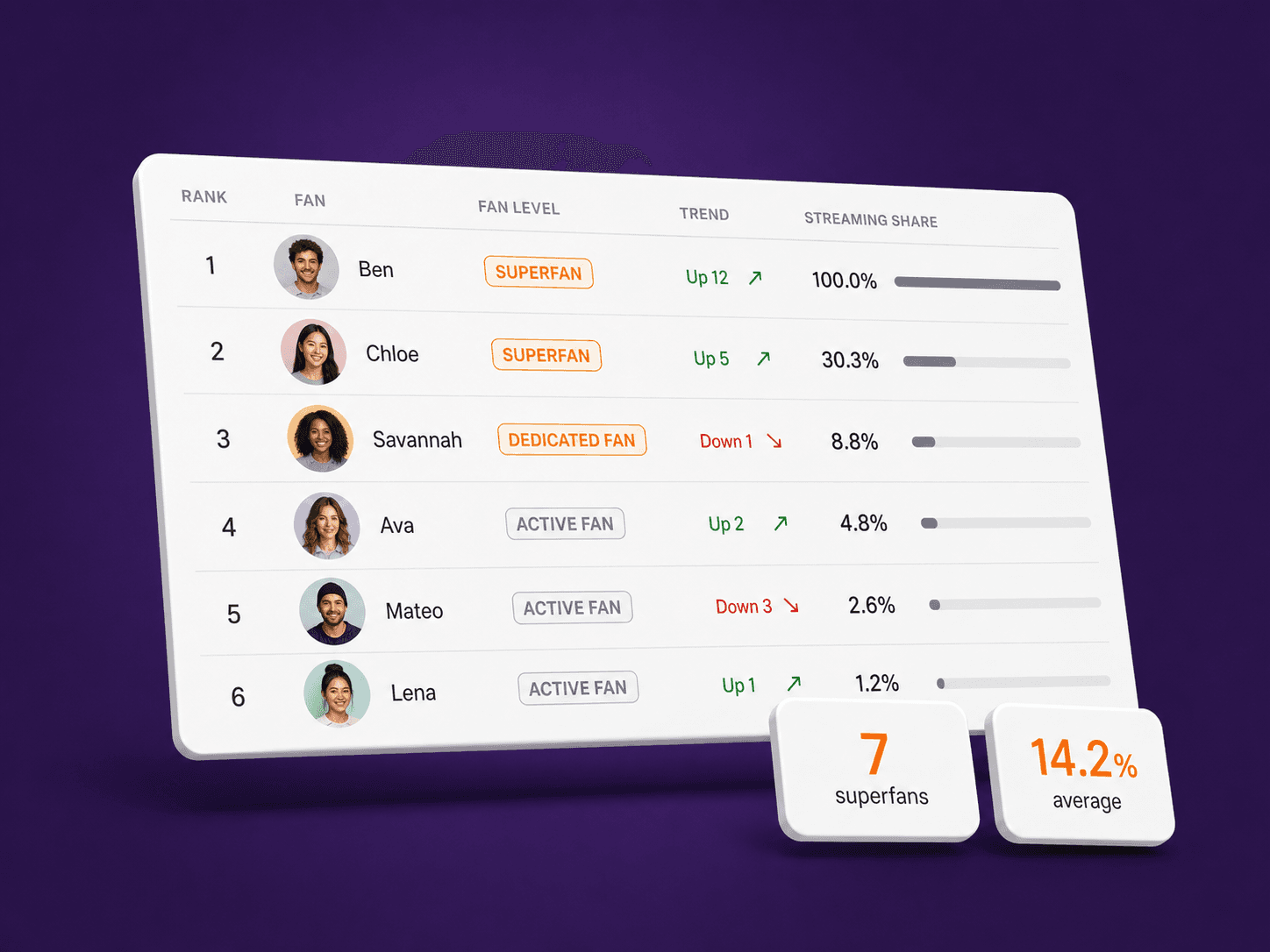
Four complaints share one cause
Artists describe these as four separate problems. They are one problem wearing four hats.
Same message. One email goes to everybody, so it is written for an average fan who does not exist. The person who has listened for six years reads something aimed at a stranger.
Same moment. Everyone hears from you when your calendar says so. Not when they are actually paying attention.
Nothing measurable per fan. After it goes out, there is no way to tell who cared. So next time is another guess, made with exactly as much information as last time.
The wrong fans get rewarded. Presale codes, early access, the vinyl. They go to whoever opens email fastest, which is not the same thing as whoever showed up most.
Fix the timing and you still have three problems left. The only fix that touches all four is being able to tell one fan from another.
A list is not a fanbase
Look at what is actually in your email tool. Names. Addresses. A signup date, maybe a country.
Now try to answer these with only that:
- Which of these people listened to me this month?
- Who found me in the last two weeks?
- Which of them used to listen constantly and has not pressed play since spring?
- Who is about to drift away?
You cannot answer any of them, and it is not because your tool is bad. A list is a record of a moment, someone typing their address into a box, possibly in 2022. Every one of those questions is about behavior over time. The list simply does not hold that shape of information.
So the list quietly forces the only strategy it can support: send everyone the same thing whenever you have news, and hope it lands on enough of the right people.
Five different people are already on your list
Not marketing segments. Recognisable situations, and each one wants something different from you.
Brand new. Found you in the last week or two. Curious, no history, no idea who you are as a person. The most fragile group you have, and the one most likely to receive a message written for people who already know your back catalogue.
Warming up. Listening more this month than last. Actively getting into you. The smallest group and the highest leverage one, because this is what a long-term fan is made out of, and the window is short.
Steady. Your reliable core. Been here a while, listens regularly, shows up. Easy to take for granted precisely because they never cause a problem.
Cooling. The group that matters most and gets noticed least. They used to listen weekly, now it is monthly. Nothing went wrong. They have not unsubscribed and they are not angry. They are just drifting, and by the time it shows up in a monthly listener count it has been happening for a while.
Gone. Still on the list. Not listening. Every message sent to them costs a little, and the honest move is usually to stop.
One message to all five is a message to none of them.
"How often should I email?" is the wrong question
It is the question artists ask most, and it has no answer, because it assumes everyone belongs on the same schedule.
Once a week is far too often for someone who found you in March and has not listened since. Once a quarter is nowhere near enough for someone deep in your catalogue right now who would happily hear from you weekly. Any single number is simultaneously too much for one group and too little for another.
The question that does have an answer is relevance: does the person receiving this have a reason to care about it today? Get that right and frequency mostly sorts itself out. Fans do not get annoyed by hearing from artists they love. They get annoyed by hearing things that were obviously not meant for them.
Try this on Monday
Telling your fans apart is the first beat of an activation loop, and you can start it this week with a spreadsheet.
-
Export your list and add one column:
when did they arrive. Most email tools store a signup date. That single field separates "brand new" from everyone else, and brand new is the group most often mishandled. -
Write to the newest fifty people on their own. Not a newsletter. A short note that assumes they know nothing about you. Twenty minutes, and it is the highest return message on this page.
-
Add a second column:
last time I heard from them. Fill in what you actually know. Replies, comments, people who buy tickets, people who message you, people you recognize at shows. It will be full of gaps. Do it anyway. -
Find your quiet regulars and message them individually. People you remember being around who have gone silent. Ask them for nothing. No stream, no pre-save, no share. Just contact. Being asked for something is often what made them quiet.
-
Do it again in three months. Notice who moved between groups. The movement is the information. One snapshot tells you nothing. Two tell you a direction.
Noticing this at scale is where it breaks
The manual version works and is worth doing. It also has a ceiling, and the ceiling is lower than you would like.
You can hold about fifty fans in your head. Past that, "who has gone quiet" stops being something you notice and becomes something you would have to check, deliberately and repeatedly, for thousands of people, none of whom will tell you. Nobody announces that they are quitting an artist. They just stop, and the only way to catch it is to be looking on the day it happens.
That is the part that does not scale, and it is why the cooling group is the one almost every artist loses without ever seeing it go.
Common questions
- Why shouldn't I message my whole fan list at once?
- Because the people on it are in completely different places. Someone who found you last week and someone who has listened every week for three years need different things, and a message written for both is written for neither. Sending it anyway teaches your most reliable fans that your messages are not for them specifically.
- How do I tell my superfans apart from casual listeners?
- By behavior over time rather than by a signup date. Who is listening this month, who is listening more than last month, who has stopped. A contact list records that someone once typed in their address; it says nothing about any of that.
- How often should I message my fans?
- There is no single right number, because the answer depends on the fan. Frequency is the wrong question. Relevance is the right one: does the person receiving this have a reason to care about it today?