When should you actually reach a fan?
Last updated August 23, 2026
The short answer
Most artists reach fans when they have news. That is one trigger, it fires about four times a year, and it is on your calendar rather than your fans'.
Activation has two dials, not one. The goal is what you want a fan to do. The trigger is what makes it fire. Almost everyone only ever turns the first, which is why the other 361 days of the year are silent.
The calendar is not the only clock
Here is the model nearly every artist runs on. Something happens on your calendar, so you tell everyone. A single drops, tickets go on sale, the merch lands. Between those moments, nothing.
It is not wrong. A release is a real reason to talk to your fanbase, and release week matters. It is just one occasion, and treating it as the whole plan means the plan is asleep almost all the time.
Because your fans are not waiting. Every week, some of them are discovering you, some are getting properly into you, and some are quietly drifting off. None of that is scheduled, none of it appears in your calendar, and all of it is a better reason to say something than "it is Friday and I have a single out."
The days you are quiet are not neutral
Drifting is the passive version of this. There is an active one, and it is worse.
You are not the only artist courting your fans. Their attention is contested every single day, and the days you are quiet are not neutral days. Another single drops. Another tour goes on sale. Someone else's album gets a run in the group chat.
The day you go quiet is the day another artist gets louder.
That reframes the whole timing question. You are not competing with your own last release. You are competing with everyone's next one. On that view, waiting for your calendar is not just incomplete, it is a decision to cede ground on most days of the year.
Activation has two dials, not one
Once you separate them, the options stop being "email more" or "email less."
Dial one, the goal. What do you want this fan to do? Stream the record. Buy a ticket. Post about you. Pick up the merch. Come to the show. Connect, so you can see them at all. These are genuinely different asks and they suit different people.
Dial two, the trigger. What makes the message fire?
- Your calendar. A release, a tour on sale, a drop, a moment that took off. This is the one everyone uses.
- A fan's own behavior. Somebody who listened every week for two years has not pressed play in a fortnight. Somebody has doubled their listening this month. Somebody found you nine days ago and is still around.
The two dials are independent, which is the useful part. Any goal can be fired by either trigger. "Stream the new single" can fire because it came out on Friday, or because a reliable listener has gone quiet and this is a good reason to reappear in their life.
Turn only the first dial and you get four campaigns a year, all of them broadcast. Turn both and there is always something worth doing, because fans are always moving.
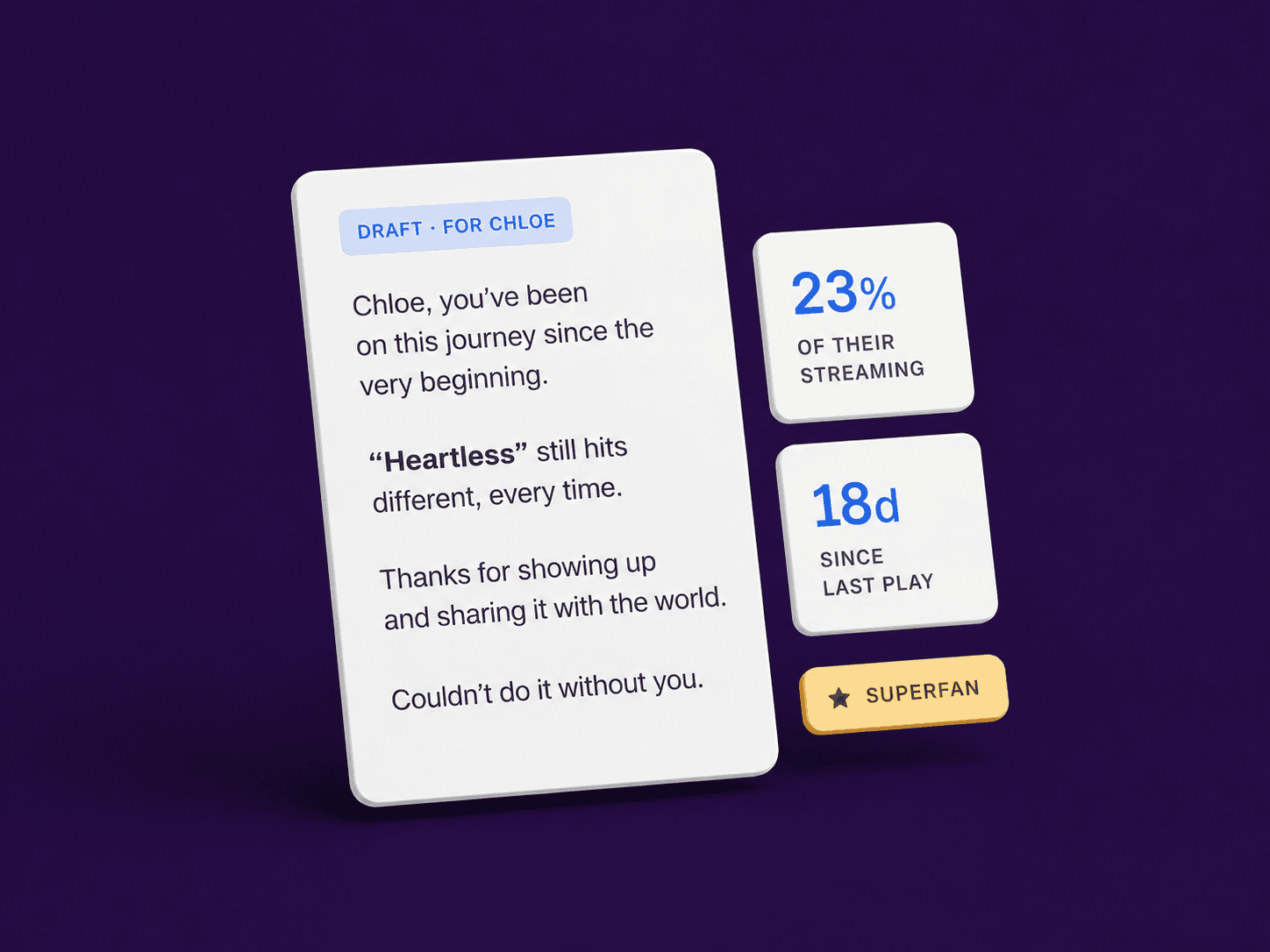
Four moments happen without your calendar
Concretely, because this stays abstract otherwise.
A regular has gone quiet. Someone who listened most weeks for a year has not played anything in three weeks. Nothing is wrong. Life happened. This is the single most valuable message you can send, and it works best when it asks for nothing.
Someone is heating up. Their listening has climbed steeply this month. They are in the middle of getting into you, which is a short window and the only one where a small gesture turns a listener into someone who tells their friends.
Someone just arrived. Found you last week. They know one song. Everything you have ever made is new to them, and a message that assumes otherwise wastes the moment.
Someone ignored the last thing. You sent something to four hundred people and a hundred acted. The other three hundred do not need the same message again louder. They need a different one, or none.
None of these is on your calendar. All of them are happening right now.
This needs something most artists cannot get
Not because it is a secret. Because it needs something most artists cannot get: a continuous, per-fan picture of what each person is actually doing.
You cannot fire on "this regular has gone quiet" unless you can see, fan by fan, who was listening and who stopped. That is the same information that tells you whether a campaign worked at all, which is why timing and measurement turn out to be the same problem twice.
Without it, the calendar is genuinely the only trigger available. That is not a failure of effort. It is a missing instrument.
Try this on Monday
You can run one fan-triggered play by hand this month, without any of the above.
-
Pick one trigger, not four. "A regular has gone quiet" is the best one to start with: highest stakes per fan, and the easiest to spot without tooling.
-
Write down what counts. Something like "someone I know was around a lot, and I have not seen or heard from them in six weeks." Vague criteria means you will find nobody, or everybody.
-
Go and find ten of them. From replies, comments, ticket buyers, people you recognize. Ten is enough. This is a test, not a programme.
-
Send a message that asks for nothing. No stream, no pre-save, no share. Something you would send a person, not a list. The whole point is that it does not read like a campaign.
-
Write down what happened, in one line, and keep it. Do it again next month with the next ten. Two rounds and you know something specific about your fans that no general advice on the internet can tell you.
Doing it at volume is where it breaks
The ten-fan version works. Then it stops.
Fan-triggered timing is not difficult in principle, it is difficult in volume. It means noticing, across thousands of people, the week each one changes, and doing something proportionate about it. That is not a campaign you run. It is a job somebody does every day.
In most artist teams that job has no owner. The artist will not sit down and run the tool, the manager is not paid to, and so it does not happen. Not because anybody is lazy. Because it is nobody's, and it is relentless.
Common questions
- When is the best time to message my fans?
- There is no single best time, because the right moment is different for each fan. The useful shift is to stop asking when you should send and start asking what should make a message fire. Your release date is one trigger. A fan's own behavior, like a regular listener going quiet, is another, and it is available every day of the year.
- What should I do between releases?
- Treat the gap as the main event rather than downtime. Fans arrive, warm up and drift away on their own schedule, none of which is on your calendar, and those changes are reachable moments. Waiting for your next release means ignoring everything that happens in between.
- How do I win back fans who have gone quiet?
- Reach them early, individually, and without asking for anything the first time. Someone drifting away has usually been drifting for a while before it shows up in any monthly total, and the message that works is contact rather than a request. Asking is often what made them quiet.